Preserving Kannada language, land and culture is every Kannadiga’s duty: KSOU VC
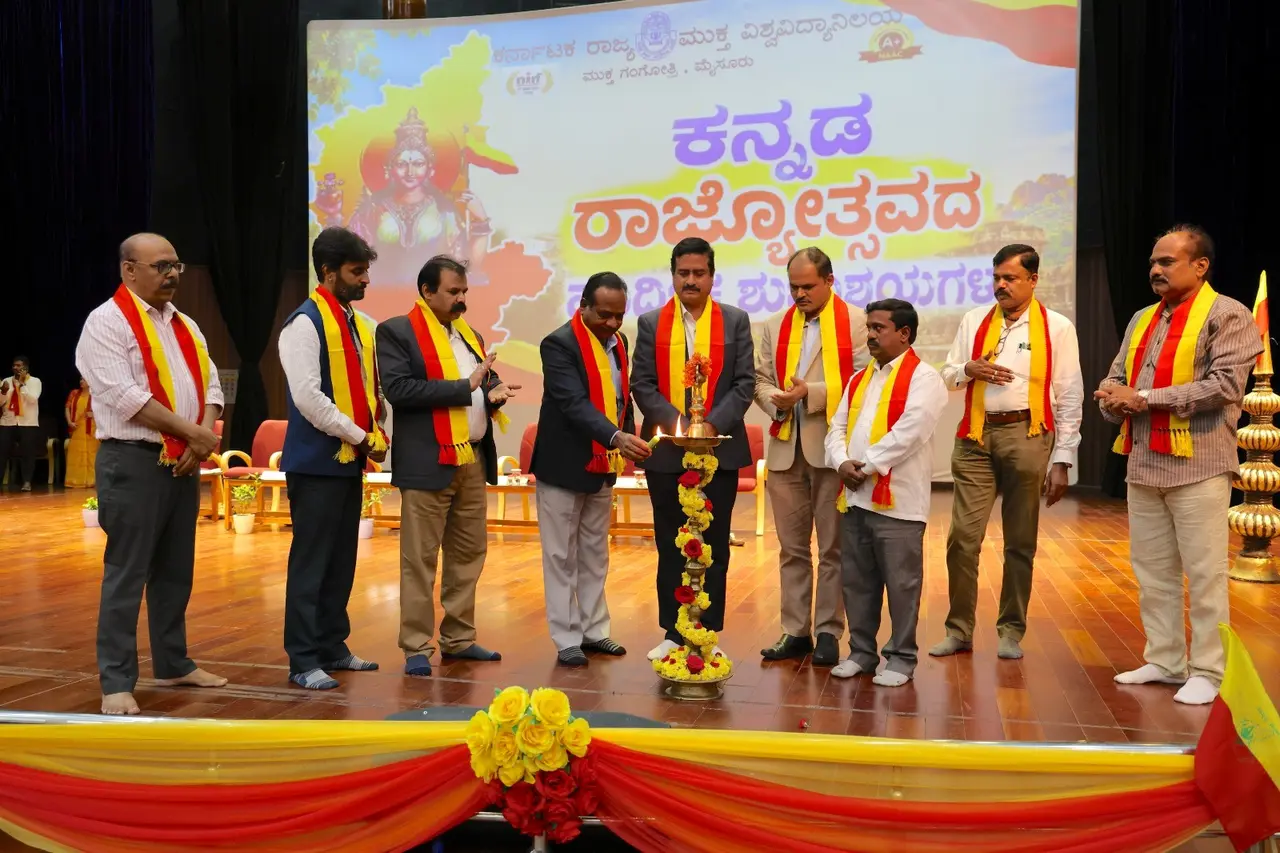
Mysuru The Karnataka State Open University (KSOU) in Mysuru celebrated Kannada Rajyotsava with enthusiasm, commemorating 70 years of the historic unification of Karnataka.
Presiding over the programme, KSOU Vice-Chancellor Prof. A.T. Gnanaprakash said November 1 was not merely a festive occasion for Kannadigas but also an important day to reflect on their duties and responsibilities towards the land, language and culture. Kannada-speaking people were once scattered across different administrative regions, including the erstwhile Mysore State, Hyderabad under the Nizam, Bombay and Madras Presidencies, and Coorg. The contributions of the Karnataka Vidyavardhaka Sangha in Dharwad, Kannada Sahitya Parishat and prominent personalities such as Aluru Venkata Rao were immense in the struggle to unite Kannada-speaking people under a single administration. Rao infused fresh momentum into the Karnataka unification movement through his writings and publications, he said.
Following the reorganisation of States on linguistic lines, the enlarged Mysore State came into existence on November 1, 1956. Subsequently, on November 1, 1973, Mysore State was renamed Karnataka. The historic achievement was made possible by the sacrifices and efforts of numerous Kannada activists, he noted.
Prof. Gnanaprakash said Karnataka was blessed with immense geographical, natural and cultural diversity. The biodiversity of the Western Ghats, extensive forest cover, coastal regions and rivers such as the Cauvery, Krishna and Tungabhadra were the lifelines of the State.
Dynasties such as the Kadambas, Chalukyas, Hoysalas and the Vijayanagara Empire had introduced Karnataka’s rich history and architectural splendour to the world. Kannada, an ancient Dravidian language, boasts a literary heritage spanning thousands of years. Its continuous evolution from the Halmidi inscription and Kavirajamarga to Vachana literature, Dasa Sahitya and modern literary works reflects its richness. The conferment of classical language status on Kannada in 2008 was a matter of pride for all Kannadigas. The language’s literary eminence was further reflected in its eight Jnanpith Awards, he said. He observed that Karnataka had emerged as one of the leading States in information technology, science, industry, education and the economy, with Bengaluru developing into a global technology hub. However, development should not come at the cost of preserving the State’s language, culture and heritage. The Kannada yellow-and-red flag symbolised the identity and self-respect of the State, he added. While remaining at the forefront of global competition in science and technology, efforts must be made to expand the use of Kannada in education, administration, employment and technology. Speaking Kannada and serving the State’s land and culture should become a matter of pride and responsibility for every Kannadiga. Only when the roots of the language remain strong can the State’s identity and future be secured, he said.
Kannada University, Hampi, Vijayanagara, Vice-Chancellor Prof. D.V. Paramashivamurthy was the chief guest. KSOU Management Board Member Manju R., Registrar Prof. M.K. Sadashiva, Dean of the Faculty of Education Prof. M. Ramanadham Naidu, Registrar (Evaluation) Dr. D.S. Anand Kumar, Finance Officer Prof. Niranjan Raj S. and Dean of the Study Centre Dr. S. Anand Raj were present on the occasion. Eom