Farmers demand 20-day Bhadra canal water release
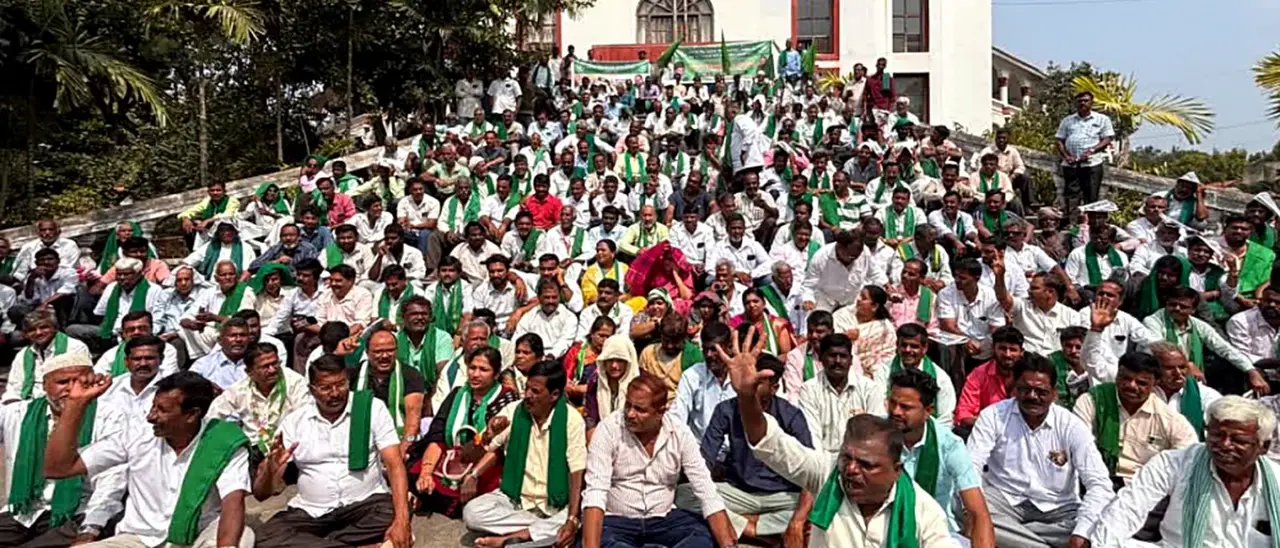
SHIVAMOGGA: Farmers staged a massive protest in front of the Deputy Commissioner’s office in Shivamogga, demanding the release of water into the left and right bank canals of the Bhadra Reservoir for 20 days to protect standing crops, including areca nut, coconut and banana.
The protest was organised by the Raitha Sangha Samuhika Nyayathvada Horata Samithi. Farmers also demanded that water be released to fill tanks and ponds in the Bhadra command area to meet the drinking water needs of people and livestock.
The farmers said their agricultural livelihoods depended heavily on the Bhadra Reservoir. With inadequate rainfall and drought conditions prevailing this year, they warned that existing crops were at risk without immediate irrigation support. Several leaders, including Shivamogga Rural JD(S) MLA Sharada Puryanaik, participated in the demonstration.
When Deputy Commissioner Prakash Nittali arrived to receive their memorandum, the protesters insisted that he return with an official order sanctioning 20 days of water supply. However, the Assistant Executive Engineer of the Bhadra Dam informed them that instructions had been received from higher authorities to release water for only 10 days. The announcement triggered strong opposition from the farmers, who maintained that 10 days would not be sufficient.
Addressing the media, farmer leader K.T. Gangadhar criticised the management of the Bhadra Reservoir and urged the government to release water for 20 days. He claimed that sufficient reserves would remain for another 100 days even after the proposed release. He also opposed diverting Bhadra water to the Upper Bhadra Project, suggesting that water from the Tunga River should instead be lifted to supply the dry plains.
Gangadhar further questioned the delay in funding the ₹5,300-crore Upper Bhadra Project, stating that an allocation of ₹300 crore could facilitate Tunga water lifting.
He urged the government to issue a formal order guaranteeing water supply, including for the next five months, and said farmers should not have to repeatedly protest to secure irrigation water.