Chandrayaan-3 and Aditya-L1 showcase India’s growing space prowess, says PM
PM dedicates COSMOS-Mysuru, the world’s first tilted LED dome planetarium, to the nation at the foothills of Chamundi Hill
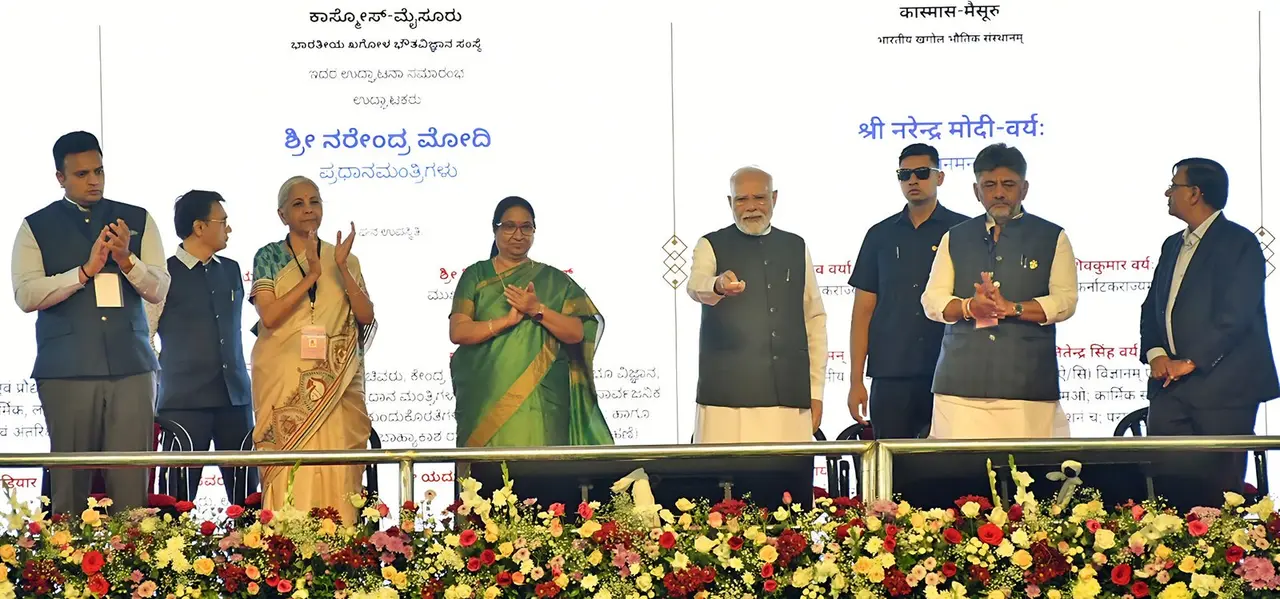
MYSURU: Science and spirituality have always evolved hand in hand in India’s rich civilisational tradition. While spirituality inspires us to look within, the study of the universe encourages us to raise our eyes towards the skies, said Prime Minister Narendra Modi.
He was speaking after dedicating COSMOS-Mysuru, the world’s first tilted LED dome planetarium, to the nation at the Jayachamaraja Wadiyar Centre for Higher Learning at the foothills of Chamundi Hill here on Friday.

A section of the audience at the event.
Expressing happiness over his return to Mysuru, Modi recalled that he had visited the city a few months ago to participate in an event associated with Swami Vivekananda. “Today, I have had the privilege of dedicating the COSMOS planetarium to the nation,” he said.
Recalling India’s glorious astronomical heritage, the PM said ancient Indian scholars meticulously observed the skies, studied the movements of stars and planets, prepared calendars and accurately calculated the timings of solar and lunar eclipses.
Great astronomers and mathematicians such as Aryabhata, Varahamihira and Bhaskaracharya had made remarkable contributions to astronomy. Despite the absence of modern instruments and advanced technology, they carried out pioneering research and solved highly complex mathematical problems.
Highlighting Mysuru’s contribution to education and scientific research, Modi said the city had a long-standing tradition of establishing institutions that encouraged learning, innovation and research. The University of Mysore was established during the reign of Nalwadi Krishnaraja Wadiyar, while the Wadiyar royal family also played a significant role in the establishment of the Indian Institute of Science (IISc) in Bengaluru. These institutions had opened up new avenues for generations of students, scholars and researchers.
At a time when India was making one scientific breakthrough after another, COSMOS-Mysuru had added a new chapter to the country’s scientific journey. Describing COSMOS as India’s first LED dome planetarium, Modi said the state-of-the-art facility was dedicated to the youth and people of the country. He said he had the opportunity to watch a presentation at the planetarium and found it an extraordinary experience.
He congratulated the Indian Institute of Astrophysics, the University of Mysore, various government departments and everyone associated with the development of the ambitious project.
Recalling India’s inspiring national slogans, Modi said the country had long been guided by the motto ‘Jai Jawan, Jai Kisan’. Former Prime Minister Atal Bihari Vajpayee had added ‘Jai Vigyan’ to it, while he had introduced ‘Jai Anusandhan’ to underline the importance of research and innovation. India in the 21st century is moving forward with this vision, and the country’s youth are making remarkable achievements.
He cited the outstanding performance of Indian students in international science Olympiads as evidence of the country’s growing scientific talent. At the International Olympiad on Astronomy and Astrophysics held in Vietnam this year, four of the five-member Indian contingent won gold medals, while the fifth student secured a silver medal, bringing pride to the nation. Indian students had also achieved impressive results in international Olympiads in mathematics, physics, chemistry and biology, winning several gold and silver medals.
India on global space map
Emphasising the rapid transformation brought about by technology, the Prime Minister said no country could afford to lag behind in the emerging technological landscape.
Over the past decade, India had made unprecedented progress in astronomy, astrophysics and space exploration. New telescopes had been established, while the country had emerged as one of the few nations capable of undertaking complex space research missions, he said.
Highlighting India’s landmark achievements, Modi said Chandrayaan-3 had made India the first country to land near the Moon’s south pole. Through the Aditya-L1 mission, India had launched its first space-based solar observatory to study the Sun. India had also become the fourth country in the world to demonstrate space-docking and undocking capabilities. The Union Government had opened up the space sector to private players, creating unprecedented opportunities for startups and young entrepreneurs to demonstrate their capabilities. Today, young Indian entrepreneurs were developing and launching their own rockets, placing satellites into orbit and undertaking innovative experiments that were previously unheard of in the country.
Encouraging innovation, developing new technologies and creating opportunities for the younger generation were central to the scientific vision of a New India, he said.
India’s space programme dedicated to human welfare
Stressing that India’s scientific and space programmes were guided by humanitarian concerns, Modi said the country had always placed the welfare of humanity at the centre of its development priorities.
ISRO had developed a special satellite-based system to enhance the safety of fishermen, demonstrating how advanced space technology could directly benefit ordinary citizens.
Planetariums and science centres had a crucial role in creating the right environment and inspiring the next generation of scientists.
He appealed to the COSMOS-Mysuru management and all concerned authorities to organise special programmes and make arrangements to encourage large numbers of school and college students to visit the facility. “Some of the children who visit this planetarium to understand the mysteries of the universe may become scientists in the future. They may undertake pioneering research, make new discoveries and introduce their innovations to the world,” he said.