Voyager one nears another historic space milestone
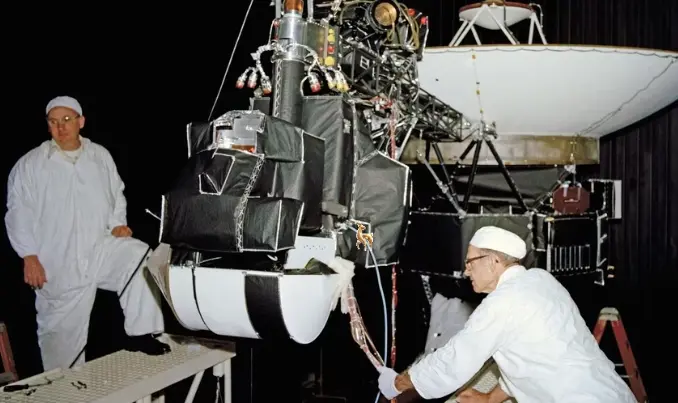
Washington Voyager 1 is expected to reach a distance of one light-day from Earth on November 18, marking another milestone for the most distant spacecraft ever built. At that point, the probe will be about 25.89 billion kilometres away. A radio signal travelling at the speed of light would need 24 hours to cover the distance between Earth and the spacecraft. Launched in 1977, Voyager 1 has spent five decades exploring space. It became the first spacecraft to enter interstellar space in August 2012, passing beyond the region dominated by the Sun's wind. The probe also captured the Pale Blue Dot photograph, which showed Earth as a tiny point against the darkness of space. Its twin, Voyager 2, launched in the same year and later visited Jupiter, Saturn, Uranus and Neptune. It remains the only spacecraft to have studied all four giant planets at close range. Both probes carry Golden Records, discs containing greetings in 55 languages, music, pictures and sounds representing life on Earth. Each record has a protective cover with instructions for playing it and diagrams showing the Sun's location using pulsars as reference points. Voyager 1 briefly stopped communicating in October. Signals were missing on October 18 and 19, but contact returned on October 20 before engineers sent repair commands. The approaching milestone highlights the distance covered since launch. Even an exchange of messages will require two days, showing how far this distant robotic explorer has travelled.