BJP MP Tejasvi Surya refutes state’s 84% claim
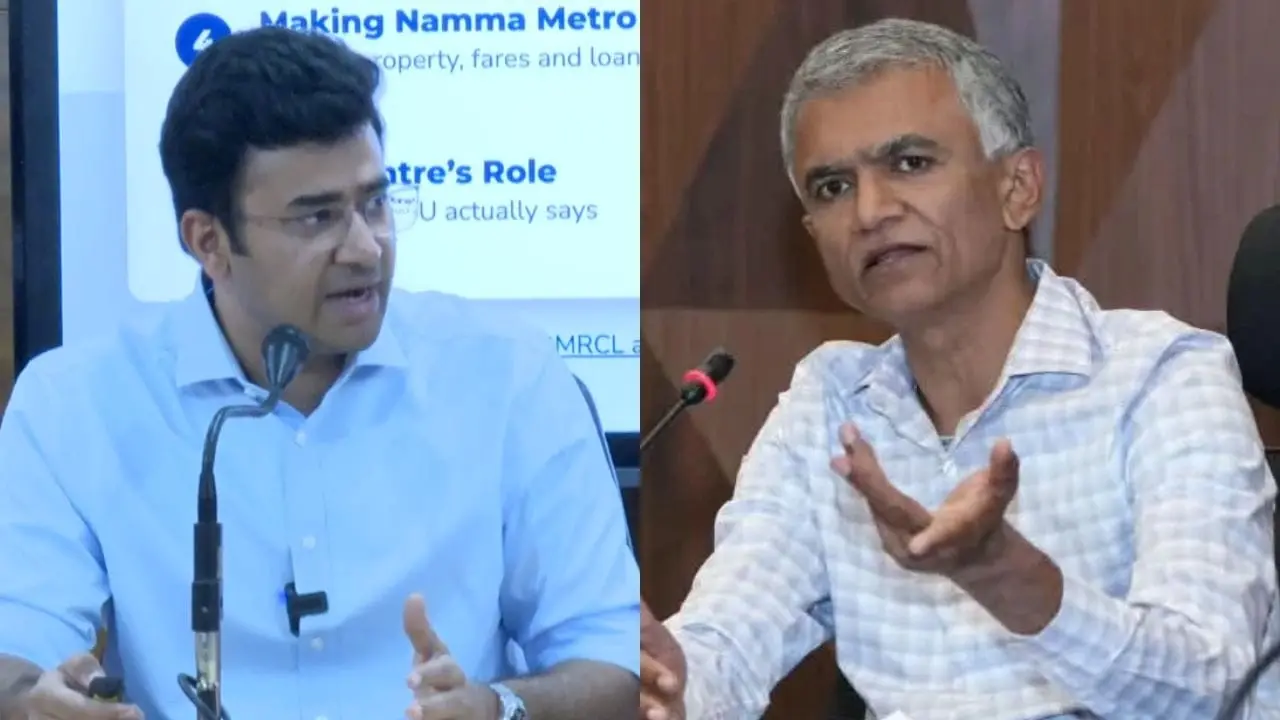
CH NEWS, BENGALURU BJP Member of Parliament Tejasvi Surya has sharply criticized state leaders during a press conference, accusing Chief Minister D.K. Shivakumar and Minister Krishna Byre Gowda of misleading the public regarding the funding distribution for the Namma Metro project. Surya asserted that state officials have incorrectly categorized foreign institutional loans secured for transit expansion as the state government's own direct contribution. According to the parliamentarian, massive loans totaling ₹28,958 crore have been procured from international financial institutions for Bangalore Metro Rail Corporation Limited (BMRCL). Because these foreign borrowings rely heavily on sovereign financial backing provided by the Central government, Surya argued that they should not be counted exclusively under the state's investment tally. Addressing figures previously cited by state ministers who claimed an 84 percent state funding share versus 16 percent from the center, Surya presented a recalculated breakdown. He stated that when factoring in foreign loans backed by central guarantees, the central government's effective share stands at approximately 54 percent, or ₹41,558 crore, out of a total cumulative project cost of ₹77,891 crore. Meanwhile, the state government's actual contribution accounts for about 46 percent, or ₹36,333 crore. He strongly condemned the dissemination of conflicting funding statistics, stating that public representatives have a constitutional obligation to present accurate financial data to taxpayers. Furthermore, the MP raised concerns regarding construction expenses and project efficiency. He pointed out that Bengaluru's Phase 3A metro construction costs approximately ₹740 crore per kilometer, which outpaces comparative figures in other major urban centers such as Mumbai at ₹691 crore, Chennai at ₹532 crore, Lucknow at ₹520 crore, and Delhi at ₹405 crore per kilometer. He also noted that approximately two lakh square feet of vacant commercial space across local metro stations remains underutilized, representing a missed opportunity for non-fare revenue generation compared to other cities where stations yield significant annual commercial income. Turning to project execution, Surya claimed that prolonged delays in land acquisition for the Blue Line corridor have resulted in financial losses reaching ₹6,000 crore. Additionally, regarding the Phase 3A Red Line, he alleged that initial design cost estimates were heavily inflated before a central government review successfully trimmed the projected figures down by ₹2,406 crore, reducing estimated tunneling expenses from a high of ₹28,405 crore to ₹25,999 crore. The explosive allegations have sparked a fierce political debate across the state regarding fiscal transparency and inter-governmental cooperation in urban transit development.