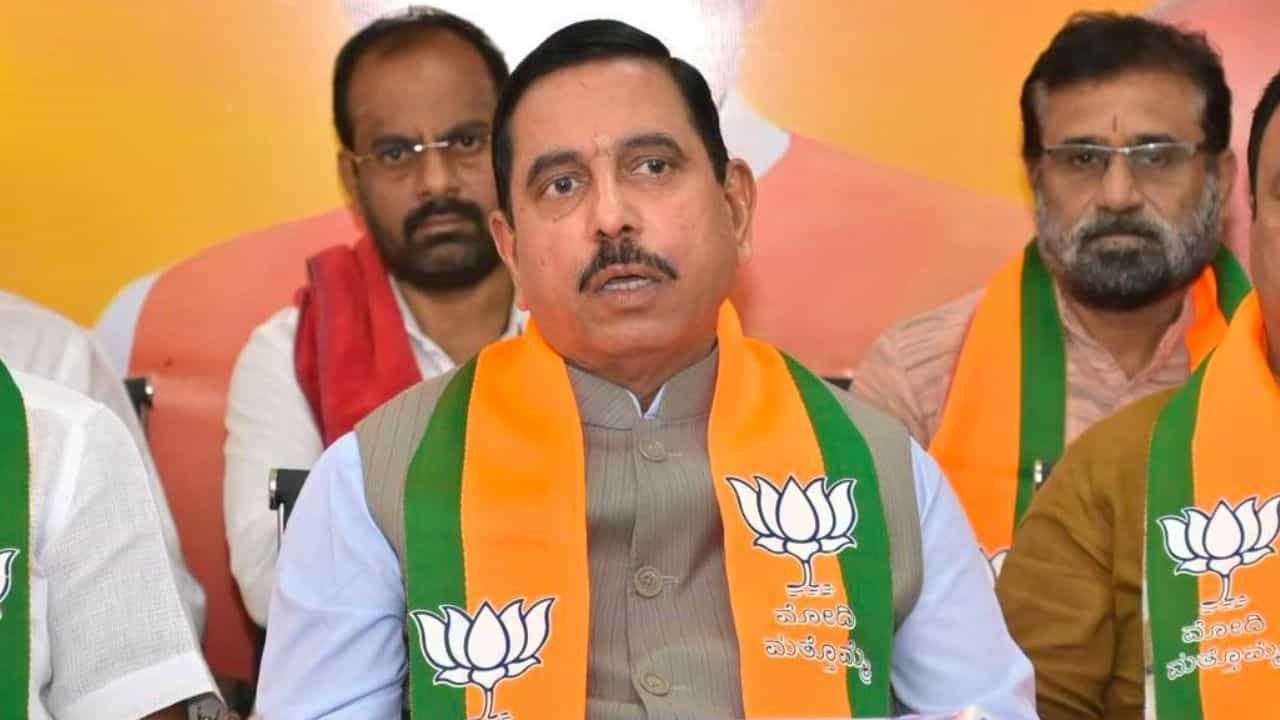
CH NEWS, BENGALURU Union Minister Pralhad Joshi launched an attack on the ruling Congress administration in Karnataka, accusing the government of blatant partisan bias, administrative decay, and severe institutional corruption. Addressing reporters, the senior BJP leader vehemently contended that the state's official drought-relief lists had been manipulated to serve narrow political interests, alleging that executive favors and calamity compensation were restricted exclusively to constituencies represented by ruling party lawmakers who exerted intense political pressure or threatened resignation. Questioning the ethical foundations of the administration, Joshi remarked, "Have you no shame or decency?" Pointing to glaring disparities in relief distribution, he asserted that regions represented by opposition legislators were deliberately bypassed, leaving agrarian communities to suffer in isolation despite acute dry-spell conditions. He further castigated the state executive for failing to disburse and utilize available financial buffers under the State Disaster Response Fund (SDRF), instead choosing to rely on a persistent pattern of deflecting blame onto the Union Government. The Union Minister drew a direct connection between the administration's aggressive rhetoric against central allocations and what he termed an internal admission of systemic insolvency. Referencing recent confidential correspondence originating from the State Finance Department that exposed crippling treasury constraints, unpaid contractor bills, and frozen capital allocations, Joshi argued that the government's constant finger-pointing at Delhi is a calculated smokescreen designed to hide its own structural bankruptcy. "They know nothing other than blaming the Centre," Joshi stated. "Fix that financial emergency first. They have stated everything else in that internal advisory except the stark reality of bankruptcy; they are manufacturing political diversions now to cover up the fact that the treasury is completely empty." Expanding his critique to systemic administrative governance, Joshi alleged that deep-rooted corruption and financial leakages have permeated every tier of the state machinery, claiming that lucrative bureaucratic positions are routinely commercialized. Pointing to recent high-profile bribery scandals involving administrative officers—including cases where mid-level revenue officials such as tahsildars were caught red-handed accepting massive illicit gratification within months of assuming sensitive postings—he questioned the transparency of executive transfers and placements managed under the current dispensation. Shifting his focus to national political dynamics and recent protests organized by the Congress party, Joshi ridiculed the opposition's stance regarding electoral institutions and democratic processes. Commenting on public remarks and press conferences led by senior national figures like Rahul Gandhi questioning electoral outcomes and institutional integrity, Joshi dismissed the criticism as an exercise in political dissonance. Contrasting the grassroots engagement of national leadership with what he characterized as intermittent political tourism, Joshi questioned the ideological coherence and electoral viability of the Congress party in contemporary Indian democracy, maintaining that public rejection of their policies stems directly from governance failures and hollow rhetoric.
Rebuttal on Electoral Controversies Turning his attention to national political developments and recent protests staged by the Congress party concerning the Election Commission, Joshi dismissed their grievances as hollow rhetoric. Mocking opposition leaders over electoral outcomes, he contrasted the grassroots campaigning efforts of Prime Minister Narendra Modi—who engaged directly with rural citizens across every corner of the country—with opposing leaders touring abroad, questioning the political viability and future relevance of the Congress party.